
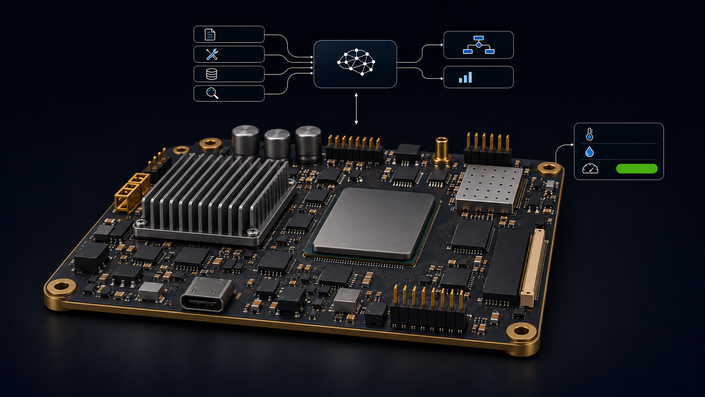
Agentic Embedded Systems: Architecture and Applications
Master Agentic AI Principles, Tool Integration, and the Engineering of Intelligent Embedded Applications.
Watch Promo
Agentic AI Is Moving Into Industrial Systems
Major industrial technology companies are beginning to integrate AI agents into engineering and operational systems.
Siemens has launched an AI engineering agent capable of planning and executing industrial automation tasks. Schneider Electric, working with NVIDIA and HPE, has introduced industrial AI agents designed to monitor operating conditions and support intelligent actions at the industrial edge. Honeywell is piloting agentic AI technology that combines equipment data and digital twins to help operators understand system conditions and coordinate responses.
These developments signal an important direction for industrial technology: AI is moving beyond generating answers and into applications that can interact with engineering systems, equipment, and real-world operations.
For embedded engineers, this creates an opportunity to develop a new class of intelligent applications.
Engineer AI Applications That Interact with Real Embedded Systems
Embedded systems already power industrial equipment, automotive electronics, robotics, smart devices, and countless other technologies. They acquire measurements, monitor operating conditions, report faults, and execute software commands.
Agentic AI introduces an additional capability: applications that can understand engineering objectives, select appropriate tools, communicate with embedded devices, and adapt their actions based on the information they receive.
This goes beyond using ChatGPT, Codex, or other AI assistants to generate firmware.
It involves understanding how to architect and develop applications in which AI agents become part of the system's functionality, working with existing embedded software and hardware.
Agentic Embedded Systems: Architecture and Applications teaches you the engineering principles behind these capabilities and how to apply them to real embedded hardware.
Understand the Engineering Behind Agentic AI
The course begins with the foundations of agentic AI as a professional software engineering discipline.
You will learn how AI agents interpret objectives, select tools, manage context, interact with external systems, and use feedback to determine their next actions.
The theoretical curriculum develops your understanding of:
- Agent Architectures and Orchestration: Understand execution cycles, planning, single-agent and multi-agent systems, and the architectural decisions behind intelligent workflows.
- Tool Calling and System Integration: Learn how agents interact with software functions, APIs, engineering tools, and external devices through structured interfaces.
- Modern Agentic Technologies: Explore the roles of LangChain, LangGraph, Model Context Protocol (MCP), context engineering, memory, and Retrieval-Augmented Generation (RAG).
- Engineering Reliable AI Applications: Understand agent evaluation, permissions, execution boundaries, error handling, and the trade-offs involved in developing trustworthy systems.
These concepts are valuable beyond embedded systems. They provide a foundation for understanding agentic applications across software engineering, industrial automation, enterprise systems, and intelligent products.
More importantly, you will understand how these technologies fit together, when they are appropriate, and when conventional software engineering offers a better solution.
Build an Intelligent AI Agent That Communicates with Real STM32 Hardware
The practical component brings these concepts together through the development of an AI-powered embedded device monitoring and operations system.
Using an STM32 microcontroller you will develop an application that enables an AI agent to communicate with a real embedded device.
You will begin by establishing reliable communication with the microcontroller and exposing its capabilities through structured functions.
Next, you will integrate an AI agent that can interpret natural-language requests, retrieve live sensor measurements, inspect device status, and select appropriate operations.
As the application develops, you will introduce goal-directed behaviour, allowing the agent to perform multistep tasks based on actual device conditions.
You will also implement controlled configuration changes, operator approval, error handling, and verification of device responses.
Throughout the project, the STM32 retains responsibility for its deterministic firmware operations and operating limits, while the AI agent provides intelligent interaction and task coordination.
The result is a practical demonstration of how agentic AI can be integrated with embedded systems, using an architecture whose principles can be extended to more advanced industrial and commercial applications.
What You'll Be Able to Do
By the end of the course, you will be able to:
- Understand and evaluate the architectures behind modern agentic AI systems.
- Design AI applications that use tools, external information, and feedback to accomplish engineering objectives.
- Integrate AI agents with embedded devices through structured communication interfaces.
- Develop intelligent, goal-directed interactions involving real sensor measurements, device operations, and verified results.
- Evaluate agent behaviour, manage execution boundaries, and identify suitable architectures for more advanced applications.
You'll gain both the theoretical understanding of agentic AI engineering and practical experience applying those principles to a real embedded system.
Who Should Take This Course?
This course is designed for embedded software developers, firmware engineers, RTOS developers, embedded Linux engineers, systems engineers, and technical professionals interested in intelligent embedded applications.
It is particularly valuable if you already use AI-assisted development tools and want to understand how to engineer applications that incorporate AI agents as part of their functionality.
Familiarity with embedded firmware development and basic Python concepts is helpful. No prior experience with AI agents, LangChain, LangGraph, or MCP is required.
The hardware practical uses an STM32 microcontroller, a compatible environmental sensor, and access to a supported AI model API.
Expand What You Can Engineer
Agentic AI is creating new possibilities for intelligent instrumentation, industrial monitoring, equipment management, robotics, and connected embedded products.
Understanding its architecture, integration methods, and engineering limitations provides a foundation for developing these applications and progressing into more advanced agent frameworks, industrial AI systems, and autonomous workflows.
Develop the knowledge and practical skills to engineer AI applications that understand requests, interact with real embedded hardware, and produce verifiable results.
Enroll in Agentic Embedded Systems: Architecture and Applications.
Frequently Asked Questions
Your Instructor
EmbeddedExpertIO represents a vibrant collective dedicated to the mastery of sophisticated embedded systems software development for professionals.
Our core objective is to equip individuals and organizations with the indispensable skills to thrive in the swiftly evolving embedded systems sector. We achieve this by providing immersive, hands-on education under the guidance of seasoned industry specialists. Our ambition is to emerge as the favored learning platform for embedded systems development professionals across the globe.